 Above, by Archie Waugh.
Minggu, 11 September 2011

Sabtu, 10 September 2011
Meet Godzilla

There's a new book on Godzilla coming out!
Monsters In Motion.com has posted the following;
Meet Godzilla By Robert Greenberger
This book introduces the reader to the American version of Godzilla as well as to the original Japanese version. From production to special effects, the movie and the international sensation it created are chronicled. Readers will learn how Godzilla represents the beginning of a modern-day myth created to address concerns about atomic weaponry in Japanese society after the U.S. bombing of Hiroshima and Nagasaki. Add these Library hard bound books to your monster collection. Published in scholastic old school style of the 50's-60's-70's. Photos included. Great for introducing it to your kids or library of fear.
Included is ordering information.
The price: $20.99.
Shipping date: October 3.
For more information, go here.
Jumat, 09 September 2011
PRESERVING GODZILLA
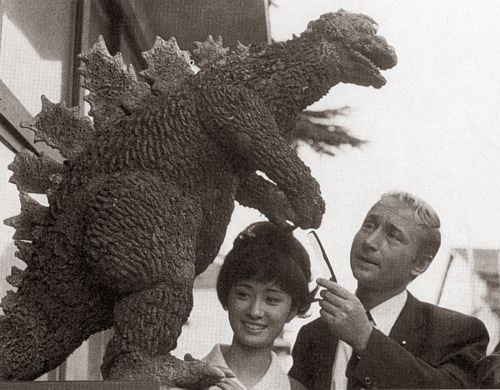
Ten years ago, I wrote the following article on Toho's efforts to preserve their film library of kaiju movies for G-FAN magazine (issue no. 48). I thought now would be a good time for a revisit.
by Armand Vaquer
Do you wonder if Godzilla will be around for future generations to enjoy? This thought occurred to me when I set out to check on the state of Toho’s classic Godzilla films and what efforts are being made to ensure that the “King of the Monsters” will be around for generations to come.
I recently checked on the subject of film preservation and restoration with the American Film Institute (AFI) and found that our film heritage is in pretty good shape, at least for now. The thought also occurred to me, “ What is being done in Japan by Toho Co., Ltd. in preventing film deterioration?” I will state my findings herein.
Background.
As many of you motion picture fans know, film deterioration has been a major concern during the past several years. Many studios and the American Film Institute have in place programs to restore, preserve and protect films of varying ages and film types.
Several years ago, concern was raised over the loss of films before 1951 that were on nitrate-based film stock. Nitrate film stock turned out to be unstable, flammable and deteriorates after several years. When it was realized that we were losing our old films, efforts began to transfer these films from nitrate stock to modern safety film. Thanks to these efforts, older nitrate films were saved and not lost to the ages as some had already been.
Another concern was that color films were deteriorating (even though they were on safety film) because of the single strip film emulsion also proved to be unstable. It has been learned from bitter experience that unlike the earlier three-strip Technicolor film process, today’s color film can fade irretrievably in as little as five years (note that Lucasfilm had to restore the earlier “Star Wars” films before they could be re-released just prior to the release of “The Phantom Menace”).
According to the AFI, “There is no practical solution for preserving the color in single-strip emulsion safety film.”
Then there’s also “The Vinegar Syndrome.” Modern safety film bases are composed of either acetyl cellulose (triacetate) or polyester (product names “Estar” or “Cronar”). When exposed to flame, modern safety film will only curl and extinguish itself. When modern safety film is properly stored, it should not decompose over time and is estimated to have a shelf life about as long as that of good quality paper, approximately 200 to 300 years. Shrinkage and brittleness will also be minimized in films that are properly stored.
However, during the past several years, archivists and technical experts have learned that triacetate film is not always as stable as was originally thought. Acetate degradation has been identified as a new and potentially serious problem for preservationists. Commonly referred to as “the vinegar syndrome” (because of a vinegar-like odor is given off by deteriorating acetate), acetate degradation proceeds in a way not dissimilar to nitrate deterioration, but without the flammability factor. This problem has proven to be especially serious in films improperly stored in high temperature and humidity environments. It is also believed to be contagious, that degrading acetate can infect other films stored in the same area.
Toho’s film library.
Fortunately for us kaijulogists, although there had been kaiju eiga films ("Godzilla", 1954 and "Godzilla Raids Again", 1955) made with nitrate-based film stock, Toho had transferred all original nitrate films to non-flammable safety film. Therefore, no Toho Co., Ltd. kaiju films have been lost due to nitrate deterioration. Like the United States film industry, the Japanese film industry ceased using nitrate-based film stock and started using safety film in the late 1950s.
What of the Godzilla color films? Toho reports that they have the original negatives/master materials of their kaiju eiga films in their best possible conditions. Toho has been aware of the “vinegar syndrome” and has been paying due attention to temperature/humidity control of their film vaults. This has been perfected by Toho’s introduction of their new storage facility for original negatives with a more advanced temperature and humidity control system, called PPM Centre, three years ago.
According to Stuart Galbraith’s book, “Monsters Are Attacking Tokyo!,” Toho primarily used Eastman Color for their color kaiju eiga films. So it appears that the three-strip Technicolor process was never used for their films. U.S. releases of some films ("King Kong vs. Godzilla" (1963) for example) were printed in Technicolor.
On the video and DVD road.
The advent of home video (originally in Beta and VHS formats) in the 1980s allowed Godzilla fans to collect their favorite kaiju films. Often these mass-produced videos had picture qualities that varied as much as the designs of Toho’s monsters. Everyone is pretty much in agreement that the video quality depended upon the original source material.
For example, some companies (Simitar, for one) released video tapes of the classic (or Showa) Godzilla films and often the film prints used left much to be desired. It was through either indifference or economy that this is the case. Many of the video tapes that I have purchased had faded images, choppy editing or horrible sound. Then there are other video distributors who had an excellent print to work with and therefore produced a fine video. Some companies issued videos in EP (extended play) speed that would accentuate an already bad print.
With the introduction of digital DVD in the 1990s, kaiju collectors are able to enjoy superior video and sound on their players. Most, if not all, Heisei series Godzilla films are starting to be released in DVD. This allows for a superior product to be produced before film deterioration to sets in. [Note: Godzilla movies are now starting to be released on Blu-ray. - A.]
At present, there are no programs at Toho to restore their older kaiju films a la Lucasfilm and others. This may be due to the costs involved (in the U.S., AFI reports that the cost to preserve color images can easily be $40,000 per feature-length film), the quality of negatives and storage facilities involved. I have a copy of “Godzilla vs. Ebirah” that has excellent color images, and that film is around 35 years old. I have also seen different prints of “King Kong vs. Godzilla” (1962) and each one had color images that looked as though the film was made this year or pretty close to it.
At present, according to AFI, the only cost-effective means of dealing with color fading is to slow it down by storing color films in vaults designed to maintain below-freezing temperatures and low humidity. This is a stopgap measure. While cold storage may prolong the life of color films, it cannot ensure their survival until the time when it may be possible to transfer the images to an archivally stable medium. It was hoped that digital archiving would accomplish this, but it appears that digital images may not be as perpetually stable as was originally thought or hoped for. The jury is still out on this aspect and it depends upon whom you talk to.
But for the short term at least, we can still enjoy vibrant images of Godzilla in his nearly five decade long adventures.
Sources: American Film Institute, Toho Co., Ltd. (L.A.) and “Monsters Are Attacking Tokyo!” by Stuart Galbraith IV.
©2000 Armand Vaquer
Toho La Brea Theatre
Godzilla Preyed Here

by Armand Vaquer
This church (now the Korean Bethel Christian Presbyterian Church) was once the Toho La Brea Theatre which ran films from Japan. (Toho also opened a theater off-Broadway in Times Square in the 60s.) The Toho marquee was removed in the mid-1980s. Prior to it being the Toho Theatre, the theatre was part of the Fox Theatre chain.
In the DVD for the film How The West Was Won, there is a featurette in which you can see a shot of it as the Fox theater.
The theatre had seating for 900 and had a single screen. The location of the old Toho La Brea Theatre is at 857 S. La Brea Avenue, Los Angeles.
Unfortunately, there are no photographs of the theatre when it was the Toho. Toho Co., Ltd. does not have a photo of it in their files. If one of you fans out there has a personal photo of the theater when it was the Toho, please submit a copy.
I'd be happy to publish it!
by Armand Vaquer
This church (now the Korean Bethel Christian Presbyterian Church) was once the Toho La Brea Theatre which ran films from Japan. (Toho also opened a theater off-Broadway in Times Square in the 60s.) The Toho marquee was removed in the mid-1980s. Prior to it being the Toho Theatre, the theatre was part of the Fox Theatre chain.
In the DVD for the film How The West Was Won, there is a featurette in which you can see a shot of it as the Fox theater.
The theatre had seating for 900 and had a single screen. The location of the old Toho La Brea Theatre is at 857 S. La Brea Avenue, Los Angeles.
Unfortunately, there are no photographs of the theatre when it was the Toho. Toho Co., Ltd. does not have a photo of it in their files. If one of you fans out there has a personal photo of the theater when it was the Toho, please submit a copy.
I'd be happy to publish it!
Kamis, 08 September 2011
Monster Japan Travel Guide Autumn Discount

Summer vacation season is over. But people wanting to visit Japan can still enjoy a holiday vacation.
Autumn is one of the most enjoyable seasons to visit Japan with fall colors adding to the country's beauty. The heat and humidity of the Japanese summer are gone and more moderate temperatures makes an autumn visit a pleasant experience. Also, there are fewer crowds at the more popular tourist attractions and bargains in airfares and accommodations can be obtained.
Fans of Japanese science-fiction and fantasy movies can also take advantage of the fall discount of "The Monster Movie Fan's Guide To Japan." From the first day of autumn, September 23 (celebrated in Japan as Autumnal Equinox Day) to October 10, which is Sports and Fitness Day in Japan, "The Monster Movie Fan's Guide To Japan" can be purchased at 20% off the cover price. Instead of $15.00 per copy, it will be available for $12.00 per copy, plus $2.00 shipping and handling for a total of $14.00 USD. That's a $3.00 savings per copy!
Orders postmarked from September 23 up to and including October 10 are entitled to the discount. This offer is only available direct from the guide's author, Armand Vaquer, and not through ComiXpress.com.
To order, send your check or money order payable to Armand Vaquer at 18618 Collins Street, #105, Tarzana, California 91356.
A Day In Infamy Remembered
Above, by Archie Waugh.This generation's Pearl Harbor occurred ten years ago this coming Sunday. The memory of that day is forever etched into the minds of those alive that day, just as the Pearl Harbor attack on December 7, 1941 and the assassination of President Kennedy on November 22, 1963 with earlier generations.
 Above, the World Trade Center in New York under attack.
The day started out routinely. I was working for a security patrol company and as a temp at Farmers Insurance Company. I was working the two jobs as I was about to make my first trip to Japan in October. I had purchased my passport only days before September 11, 2001.
On the morning of September 11, I was getting ready for work at Farmers while I perused the Dave Schutz Adventures of Superman message board. On the board, I noticed some postings about some sort of incident in New York.
Reading further, I found that airplanes hit the World Trade Center. I then went over to Newsmax.com and saw multiple bulletins posted. While reading, I turned on my Sony Watchman television set that sat on my computer printer. It was then I saw the horror unfold.
I watched for several minutes until I had to drive to work. I was heading out of the house when my mom called me to tell me about the attacks. Following the telephone call, I grabbed my police scanner and headed out the door. Through the scanner, I was able to pick up radio broadcasts. I had the scanner turned on all day on my desk at work.
At Farmers, two televisions were rolled out and were kept on all day. One of the workers had a cousin in New York who worked at the World Trade Center. As the day went on, he became more frantic as his cousin hadn't been heard from. Eventually, a family member heard from her. She reported that she left the WTC minutes before the first plane hit to go to the bank. When she returned, she saw the damage to the building and pieces of body parts scattered on the ground. She wasn't allowed back in the building. She spent the rest of the day trying to get home.
 Above, the Pentagon being hit by an airliner is captured by a security camera.
As the day progressed, the news got even worse. Reports came in that the Pentagon was also attacked and a plane crashed in Pennsylvania (it was bound for Washington, D.C.)
Jessica, my roomie, told me the other day that she was living in the Bronx (roughly 30 miles away) at the time of the attacks. From there, she could see and smell the smoke from the WTC.
Almost two months later, I took my first trip to Japan. When I arrived at Los Angeles International Airport on October 31, National Guardsmen were still stationed in the airport terminals.
We are still feeling the aftermath of the September 11 attacks. Airport security
has been greatly tightened (often bordering on civil rights issues) as have security in government and private industry facilities.
Thankfully, we have not been attacked again due to the work of our servicemen and servicewomen as well as out intelligence agencies. Although we have not been attacked since, to lower our guard would be folly.
It can happen again.
"The Monster Movie Fan's Guide To Japan" Back In craigslist
 Above, Miki Hayashi with "The Monster Movie Fan's Guide To Japan." Photo by Armand Vaquer.
The Monster Movie Fan's Guide To Japan is back in craigslist.
What's craigslist?
According to them, craigslist is:
Local classifieds and forums - community moderated, and largely free. Jobs, housing, goods, services, romance, local activities, advice - just about anything really.
To see the ad go here.
Langganan:
Postingan (Atom)